What Changed in Twelve Months
Capability, scale, energy, and the fraction of a model that actually does the work — the pace argument, told in hard, sourced numbers before any of it gets opinionated.
Any piece written about AI infrastructure risks being outdated before it’s published. I think that risk is itself the first fact worth establishing: the pace of change over the last year isn’t a rhetorical flourish. It’s measurable, and it changes what “conservative” and “aggressive” planning assumptions should mean for anyone designing the systems underneath this technology.
This post lays out that pace in six parts: capability, scale and the pace of new releases, energy, the fraction of any model that actually does the work, a cost the industry hasn’t fully priced in yet, and memory.
Capability moved faster than the benchmarks built to measure it
Humanity’s Last Exam is a 2,500-question benchmark deliberately built from expert-level questions across every field — specifically because older benchmarks like MMLU had become saturated. Watch what happened to the top score:
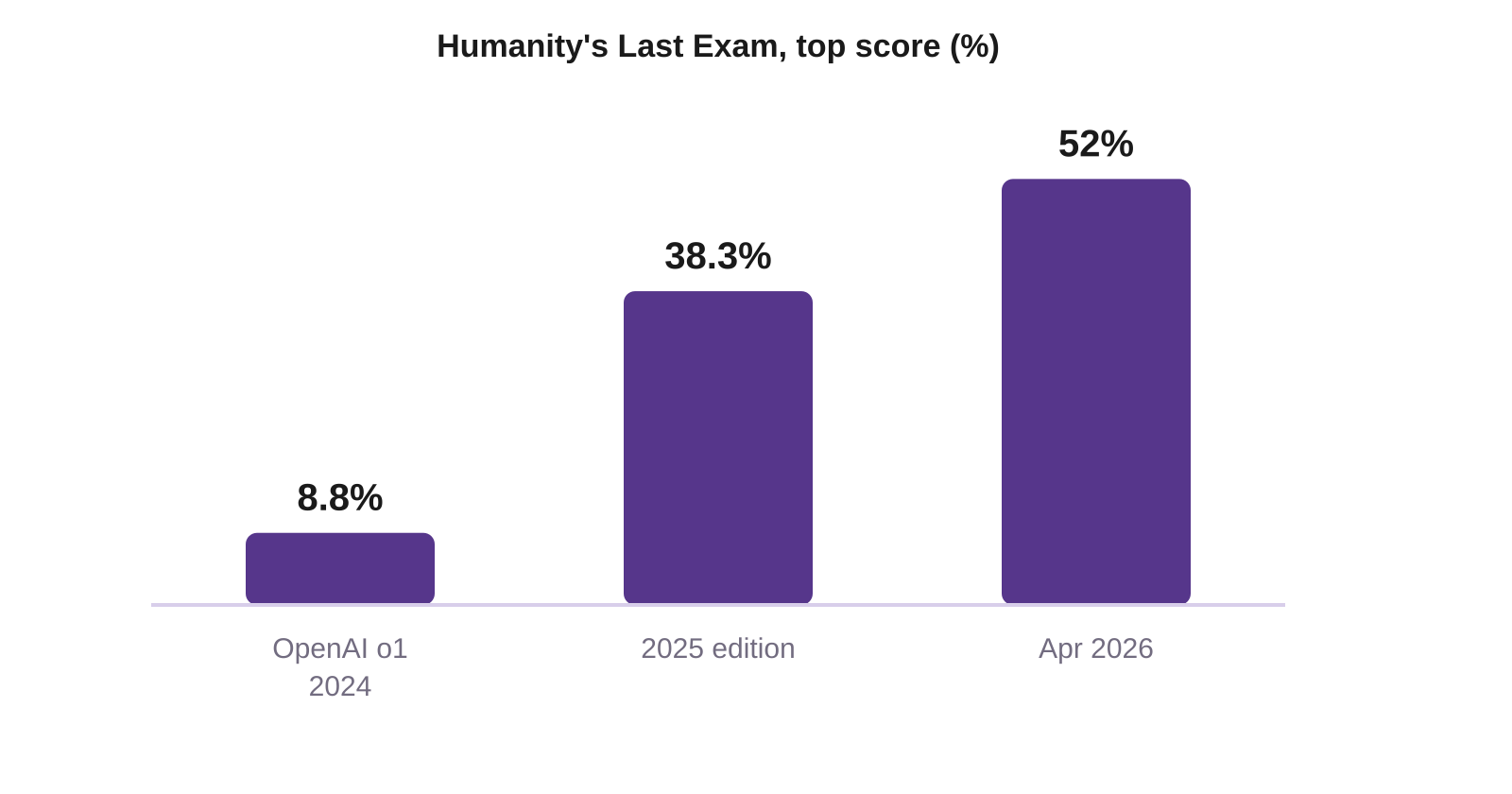
Over the same period, SWE-bench Verified — which hands a model a real, unresolved bug from a real software project and checks the fix against that project’s own tests — went from a top score of 60% to nearly 100%. Adoption moved in step: four in five university students now use generative AI regularly for coursework, a usage pattern that looks nothing like the earlier, narrower wave of enterprise pilots.
A benchmark used to illustrate “fast” in this post will likely look outdated again within another eighteen months. I think that instability is itself informative. Source: Stanford HAI, The 2026 AI Index Report.
But capability alone is an incomplete story, and I think it’s worth naming the catch directly: every one of the figures above measures raw capability or raw scale. None of them measures whether an agent took the right real-world action, or whether the extra parameters were actually necessary to deliver the result. On the evidence available, benchmarks are still rewarding bigger — not more intelligent. I’ll come back to this directly in Part 4.
Compute scale, and a pace that hasn’t slowed
Total AI compute capacity worldwide has grown roughly 30-fold since 2021, the first year it was systematically tracked, and more than 60% of that capacity sits on a single vendor’s accelerators. Fifty “notable” models were released by US-based organisations in 2025 alone, with China closing the gap quickly.
The pace hasn’t slowed since. In the weeks immediately before this series was written, Moonshot AI released Kimi K3 (2.8 trillion parameters total, ~50 billion active per token via a 896-expert mixture-of-experts design), DeepSeek shipped DeepSeek-V4-Pro (1.6 trillion total, 49 billion active, 1-million-token context) to general availability, Alibaba released Qwen3.8-Max at 2.4 trillion parameters — the largest open-weight release to date — and Google DeepMind brought Gemini 3.8 Flash, a deliberately distilled, efficiency-tier model, to stable general availability. Even in the same few weeks, the industry shipped both the largest open-weight model to date and a model built explicitly to be small and efficient. Scale and efficiency aren’t sequential phases the field is passing through — they’re simultaneous, competing design philosophies, and I don’t think the industry has honestly decided which one it’s actually optimising for.
The bottleneck moved from silicon to substations
Global data-centre electricity demand reached roughly 565 terawatt-hours in 2026, up 26% in a single year, and AI-optimised server power draw is growing at approximately 84% annually — a rate that will see it overtake all conventional data-centre power draw by 2027. Roughly half of planned US data-centre construction is now delayed or cancelled, not for lack of chips, but for lack of available grid power.
Texas is the sharpest illustration of this in practice. Its ERCOT grid runs outside the two major US interconnections with a comparatively fast approval process and abundant, cheap Permian Basin gas — a combination that let Texas absorb roughly a third of the tracked US AI data-centre build-out. Yet even with that speed advantage, only 49 of 84 tracked facilities in the state are actually operational today. As SEMI’s Terry Tsao put it at SEMICON Taiwan just days before this post was written: data movement in today’s AI systems could consume more energy than computation itself — which is exactly why I’ll spend Part 3 on this in detail.
Most of a “frontier” model never touches a given query
A fact I think is under-discussed outside specialist circles: today’s leading mixture-of-experts models activate only a fraction of their total parameters per token — commonly cited figures range from roughly 9% to 15% in current architectures, and up to 40% in more conservative estimates circulating across recent papers and podcasts. NVIDIA Research’s paper making the formal case for small, specialised models argues the implication directly: most agentic work is a small, repetitive loop of specialised sub-tasks, exactly the shape of problem a smaller, purpose-built model is suited for — and reports 10–30× cost savings from routing agentic workloads accordingly, rather than defaulting to a frontier model for every step.
A cost the industry hasn’t fully priced in
I think intellectual honesty requires naming the societal costs of the current build-out alongside its benefits, even where the evidence is still developing and contested.
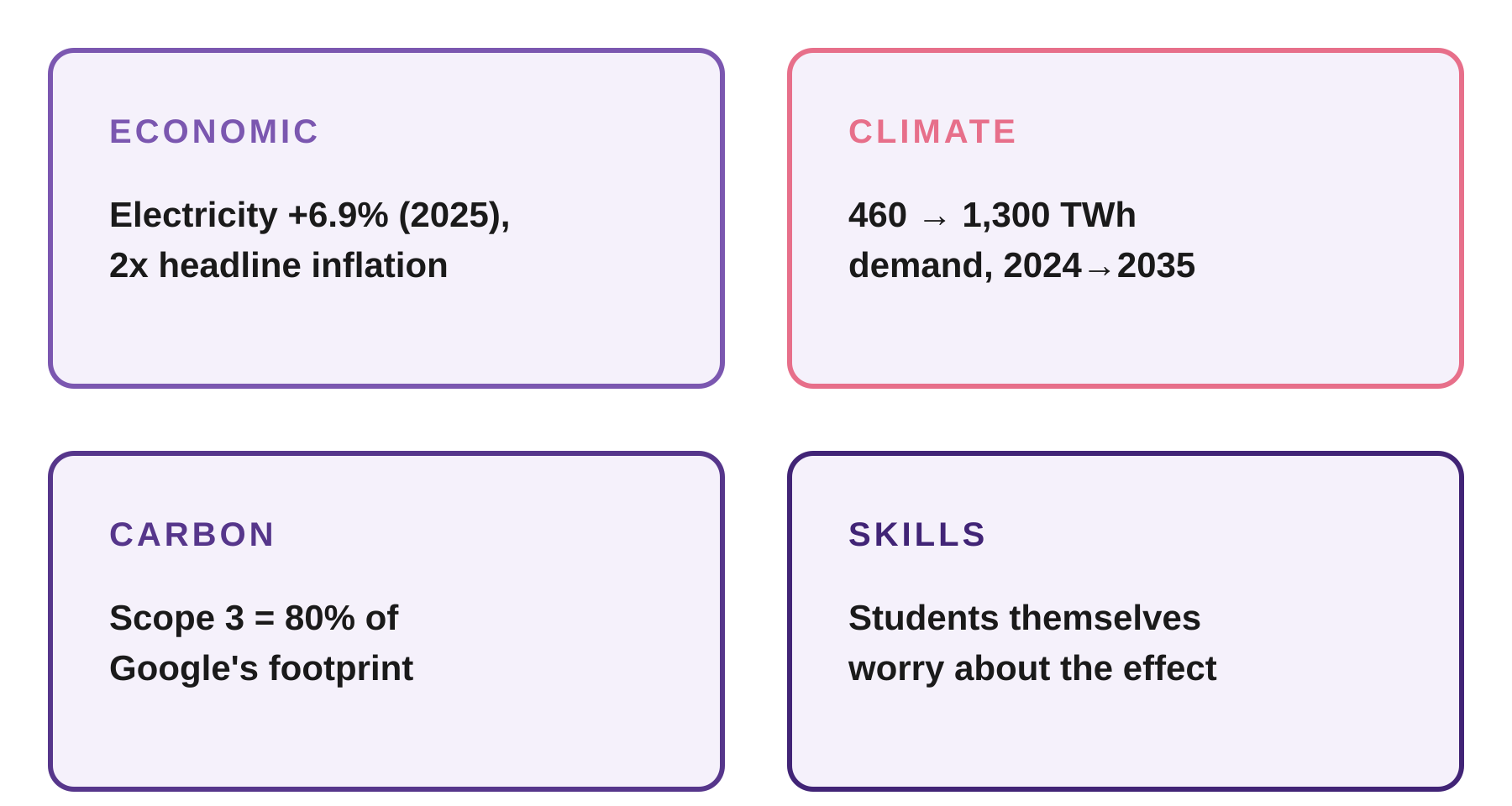
Economically: US electricity prices rose 6.9% in 2025 — more than double headline inflation — though a genuine counter-argument exists that data-centre load growth has historically spread fixed grid costs across more users, lowering per-unit prices in some cases. On climate: the 460→1,300 TWh trajectory above, with no clear efficiency offset in sight. On carbon specifically, not energy alone: Microsoft’s total emissions rose 27% in its most recent fiscal year, driven by a roughly tenfold spike in purchased-electricity emissions; Google’s supply-chain and hardware-manufacturing emissions now represent 80% of its total footprint. On skills: a 2026 RAND survey found most students who use AI for homework already worry, unprompted, about its effect on their own critical thinking — alongside genuine counter-evidence that well-designed AI-assisted classrooms report 23–35% better learning outcomes in some settings.
I don’t think any of these four questions is close to settled. I do think an industry moving this fast has an obligation to keep asking them.
Memory is the part I find most interesting
It’s clear that we are constantly talking about bigger and better reasoning in agentic systems. However, the more I work with them, the more I understand that the real currency is memory — and its corresponding privacy and ownership.
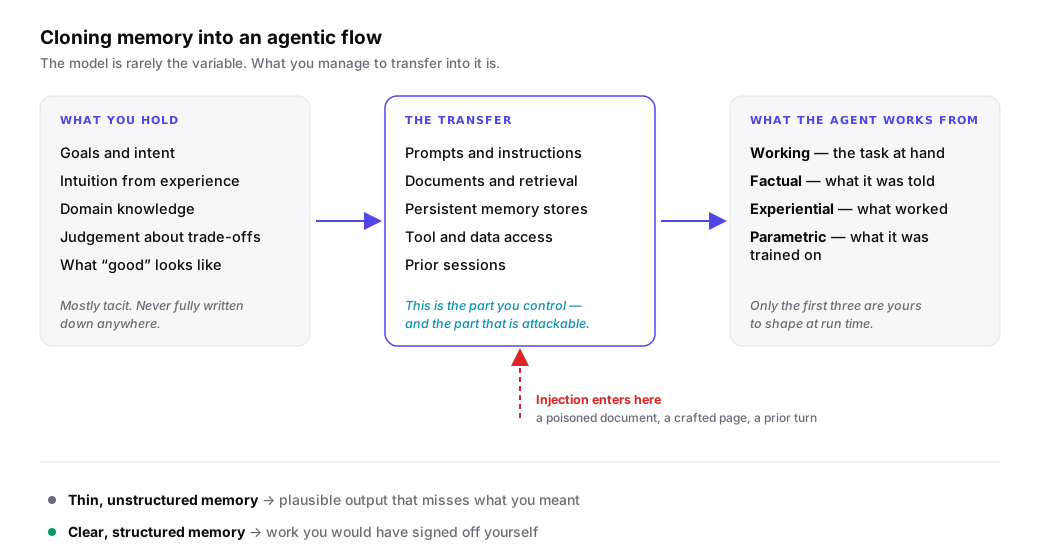
I may be wrong. But when I see talks about how dangerous current AI systems are, I find myself wondering whether it is the systems that are dangerous, or the context, prompts and data feeding them. Obviously, the big corporations may already have developed models beyond the frontier ones any of us know about. Still, if I look at the current state of the art in LLMs, attention mechanisms and the rest, I see complex models that are capable of interacting — not models yet capable of what a human brain does spontaneously. What I mean is this: if an AI system does something wrong or harmful today, it is because, by nature, either the model or its context told it to. The problem is therefore not really the AI itself. It is who is using it, and how. And perhaps not even the one using it, but the one able to inject something into it — a prompt, a document, a page — that changes how it behaves. So yes, agentic systems may take dangerous actions. But my feeling is that with the right guardrails and the right management of context and memory, there is a lot that can be done. I would not claim more than that, though, because the scope is enormous — and there is now a formal limit on it. Vassilev’s 2026 paper argues that no finite set of guardrails can be made universally robust against adversarial prompts: natural language is infinitely ambiguous, a rule set is necessarily finite, and so any fixed set will eventually be talked around. Guardrails will help. They will not, on their own, deliver governance. We will have to see how this evolves. Either way, let’s not blame the agents; let’s look at how they are used. I should admit that I am not doing research on a day-to-day basis at the moment, so I may be missing some of the most recent work — this changes by the day.
Continuing on that line of thought, I was telling the team that “intelligence”, to me, is today really about how we manage context — our own information, and the other data sources we hand to the agents. How well we transmit our thoughts, intuitions and goals to them, through prompting and other mechanisms, is what dictates how capably an agentic system delivers what we need. I generalise this as how well we can clone our memories into agentic flows so they can do the work. Poor memories and goals lead to poor results. Clear, well-structured memories and goals lead to remarkable ones. Memory is, today, one of the areas I find most intriguing — and at the same time the one with the most potential and the most work still to do. I will go deeper on it in a future entry.
References
- Stanford HAI, *The 2026 AI Index Report*.
- Lightcast, contribution to the Stanford AI Index 2026 labour-market chapter.
- International Energy Agency, "Key Questions on Energy and AI", April 2026.
- Gartner, Inc., data-centre electricity and power-demand forecast, June 2026.
- Lawrence Berkeley National Laboratory / US Department of Energy, data-centre electricity estimates, 2024.
- Silicon Report, "The AI data center power crunch: electricity, not chips, is the real bottleneck", July 2026.
- SEMI / SEMICON Taiwan 2026, Terry Tsao remarks on data-movement energy cost, September 2026.
- Belcak, P. et al. (NVIDIA Research), "Small Language Models are the Future of Agentic AI", arXiv:2506.02153, 2025.
- Local AI Zone, "Latest AI Developments: August 2026".
- Goldman Sachs, electricity-price and AI-infrastructure research, 2026.
- Microsoft, 2026 Environmental Sustainability Report.
- Google, 2026 Environmental Sustainability Report.
- RAND Corporation, "More Students Use AI for Homework", American Youth Panel, 2026.
- Hu, Y., Liu, S., Yue, Y., Zhang, G. et al., "Memory in the Age of AI Agents: A Survey", arXiv:2512.13564, December 2025.
- Vassilev, A. (NIST), "Robust AI Security and Alignment: A Sisyphean Endeavor?", IEEE Security & Privacy, vol. 24, no. 3, May/June 2026, arXiv:2512.10100.
- Cloud Security Alliance AI Safety Initiative, "Indirect Prompt Injection Goes Operational", research note, April 2026.